
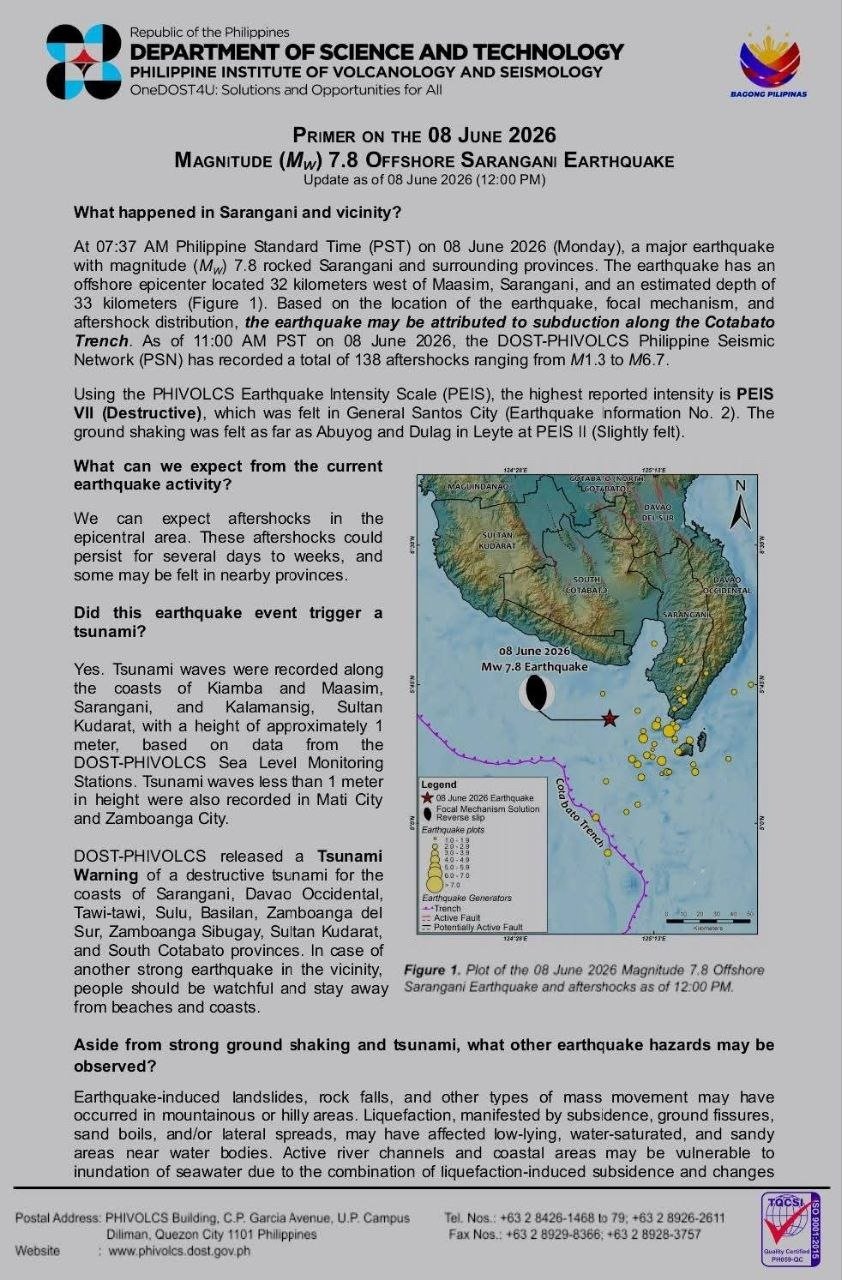
Shortly after dawn on Monday, 08 June 2026, a powerful earthquake registering magnitude (Mw) 7.8 jolted the waters off the coast of Sarangani, sending tremors across a wide swath of Mindanao and as far north as the Leyte coastline. The Philippine Institute of Volcanology and Seismology (PHIVOLCS), under the Department of Science and Technology (DOST), confirmed the earthquake struck at 7:37 in the morning, Philippine Standard Time (PST), with its epicenter situated approximately 32 kilometers west of Maasim, Sarangani, at a depth of 33 kilometers.
Cotabato Trench Identified as Fault Source
DOST-PHIVOLCS determined, based on the earthquake’s location, focal mechanism, and the distribution of subsequent aftershocks, that the event was caused by subduction activity along the Cotabato Trench. The agency confirmed the earthquake is tectonic in nature and is not associated with any volcanic event.
By 11:00 AM PST on the same day, the DOST-PHIVOLCS Philippine Seismic Network (PSN) had logged a total of 138 aftershocks, with magnitudes ranging from as low as M1.3 to as strong as M6.7, according to PHIVOLCS. Residents in neighboring provinces were cautioned that aftershocks are expected to continue for several days, and possibly weeks, with some strong enough to be felt.
Intensity Levels Across Affected Areas
Using the PHIVOLCS Earthquake Intensity Scale (PEIS), the most severe shaking was recorded in General Santos City, which experienced PEIS VII, classified as “Destructive.” Ground movement was felt across a broad geographic range — as far as Abuyog and Dulag in Leyte, where it registered at PEIS II, or “Slightly Felt.” Multiple provinces in Mindanao and the Visayas reported varying degrees of ground shaking in between these extremes.
Tsunami Generated, Waves Measured Along Southern Coastlines
The earthquake triggered a tsunami, with wave heights of approximately one meter recorded along the coastlines of Kiamba and Maasim in Sarangani Province, as well as Kalamansig in Sultan Kudarat. This data was gathered from DOST-PHIVOLCS Sea Level Monitoring Stations. Smaller tsunami waves, measuring less than one meter in height, were also detected at Mati City and Zamboanga City.
In response, DOST-PHIVOLCS issued an official Tsunami Warning for a destructive tsunami affecting the coastal areas of Sarangani, Davao Occidental, Tawi-Tawi, Sulu, Basilan, Zamboanga del Sur, Zamboanga Sibugay, Sultan Kudarat, and South Cotabato. Residents in these areas were urged to immediately move away from the shoreline and proceed to higher ground.
PHIVOLCS reminded the public of the three natural warning signs that precede a local tsunami — commonly referred to as the “shake, drop, and roar” signals. A strong earthquake is the first warning; a sudden rise or fall of seawater along the coast is the second; and an audible roar of approaching waves is the third. Anyone who observes any of these should not wait for official alerts before evacuating.
Landslides, Liquefaction, and Ground Deformation Risks
Beyond the tsunami threat, DOST-PHIVOLCS warned that a range of secondary earthquake hazards may have already occurred across mountainous and low-lying areas in the affected region. Earthquake-induced landslides and rockfalls are possible in hilly terrain, while liquefaction — which can manifest as ground subsidence, sand boils, lateral ground spreading, and fissures — may have affected low-lying, sandy, water-saturated zones near rivers, lakes, or the coastline.
Active river channels and coastal communities are also at added risk of flooding as a result of liquefaction-induced land subsidence combined with changes in sea level. The agency further cautioned that sinkholes may form in areas underlain by limestone bedrock. Slopes should be carefully inspected for newly formed tension cracks or signs of incipient failure, as aftershocks or heavy rainfall could trigger further slope movement.
No Volcanic Threat Linked to the Event
DOST-PHIVOLCS clarified that despite the earthquake’s magnitude, there is no indication of volcanic activity connected to the event. The two nearest active volcanoes to the epicenter — Matutum and Parker — are being closely monitored as a precautionary measure in accordance with standard protocols, the agency said. Continuous observation will remain in effect to detect any changes in volcanic behavior that could be influenced by the seismic event.
What the Public Should Do
PHIVOLCS issued a series of safety reminders for all residents living in and around the affected areas. The public is advised to remain vigilant and prepare for additional aftershocks. When strong tremors are felt, the “Drop, Cover, and Hold” procedure must be followed immediately — taking shelter under sturdy furniture and protecting the head and neck from falling debris.
Heavy appliances and furniture at home or in workplaces should be anchored securely to walls to prevent them from toppling during aftershocks. Buildings that have visibly sustained structural damage should not be re-entered until certified safe by a licensed structural engineer. Residents are advised to coordinate with their Municipal or City Engineering Office for structural inspection and guidance before returning to damaged structures.
Any observations of landslides or tension cracks in the ground should be reported immediately to local Disaster Risk Reduction and Management Offices (DRRMOs). The agency also warned the public against spreading unverified information and urged everyone to rely solely on official advisories released by DOST-PHIVOLCS and other authorized government agencies.
PHIVOLCS to Deploy Quick Response Team
To assess the extent of geologic impact on the ground, DOST-PHIVOLCS announced it will deploy a Quick Response Team (QRT) to Sarangani Province and surrounding areas. The team will conduct geologic impact assessments and engage in information dissemination activities to help local communities understand and respond to ongoing hazards, the agency said.
For real-time updates, the public may visit the official PHIVOLCS website at www.phivolcs.dost.gov.ph or follow the agency on Facebook and on X (formerly Twitter) at @phivolcs_dost. Earthquake observation hotlines are available at the following numbers: DOST-PHIVOLCS Main Office in Quezon City — (02) 8929-9254 and (02) 8426-1468 to 79; DOST-PHIVOLCS PMCMCET — (082) 293-0008; and DOST-PHIVOLCS General Santos Seismic Station — (083) 877-7091.
Originally reported by: Philippine Institute of Volcanology and Seismology (PHIVOLCS) — DOST-PHIVOLCS Primer on the 08 June 2026 Magnitude (Mw) 7.8 Offshore Sarangani Earthquake, Update as of 08 June 2026, 12:00 PM.
Related stories